E-invoicing software for international compliance

With efsta’s e-invoicing software, companies can create, receive, and process structured electronic invoices in compliance with country-specific requirements. The solution is integrated into efsta’s proven fiscal middleware and supports B2B and B2G across existing POS, ERP, and PMS.

Talk to an expert
A blue-purple stylized symbol of a leaf with a curved "e" on a purple diamond-shaped background.

Software for creating, processing, and sending e-invoices

efsta E-Invoicing is a compliance solution for companies that need to create, transmit, receive, and monitor electronic invoices in a structured manner. The software is not limited to a single format or specific transmission method and can be used depending on the country, system architecture, and regulatory requirements.

EU Regulation: VAT in the Digital Age (ViDA)

With “VAT in the Digital Age” (ViDA), the EU has established a uniform regulatory framework for digital VAT reporting. ViDA introduces mandatory digital reporting primarily for cross-border B2B transactions, but also applies to B2G. B2G e-invoicing is already regulated by Directive 2014/55/EU on electronic invoicing in public procurement and is merely further harmonized by ViDA.

While national e-invoicing requirements continue to be regulated at the national level, ViDA sets the overarching framework for future developments in the EU.
The European flag next to a set of scales, a judge's gavel, and two open law books.
By July 2030, companies must:
  • report cross-border transactions in near real time
  • comply with country-specific e-invoicing requirements
  • Use structured XML formats and standardized transmission channels such as Peppol
The goal is to achieve EU-wide transparency in the VAT system through digital, near-real-time reporting based on e-invoices.

efsta's solution for ViDA requirements

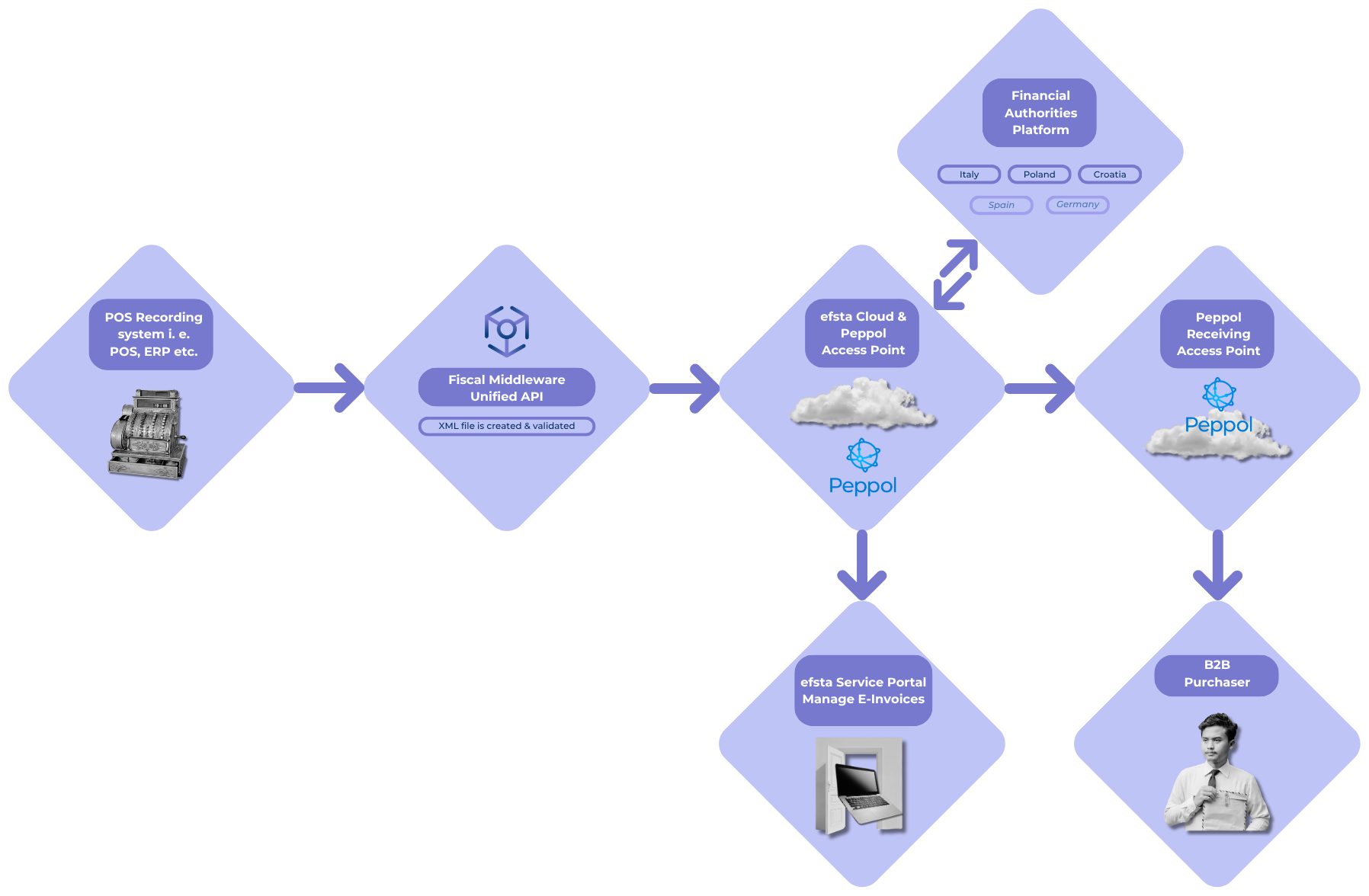
With efsta, e-invoices are generated directly from existing POS, ERP, or PMS and processed via the efsta Fiscal Middleware. Transaction data is structured, validated, and transformed into the required country-specific XML format.

Secure transmission to national platforms such as SDI, KSeF, or other government agencies, as well as to the Peppol network, is handled via the efsta Cloud and the Peppol Access Point. At the same time, e-invoices can be received and forwarded to the respective business partner.

Companies retain control over the entire process at all times: status, validation, and monitoring are managed centrally via the efsta Service Portal. This ensures consistent, compliant, and scalable processing of e-invoices across national borders.
View technical documentationFlowchart of the e-invoicing integration with the POS system, Unified API, efsta Cloud, Financial Authorities Platform, Peppol receiving point, efsta Service Portal, and B2B buyers.

E-Invoicing Software for European Countries

efsta helps companies comply with country-specific e-invoicing requirements. The solution currently covers Germany, Italy, Poland, and Belgium, among others. Additional countries will be added gradually in accordance with local regulatory requirements.
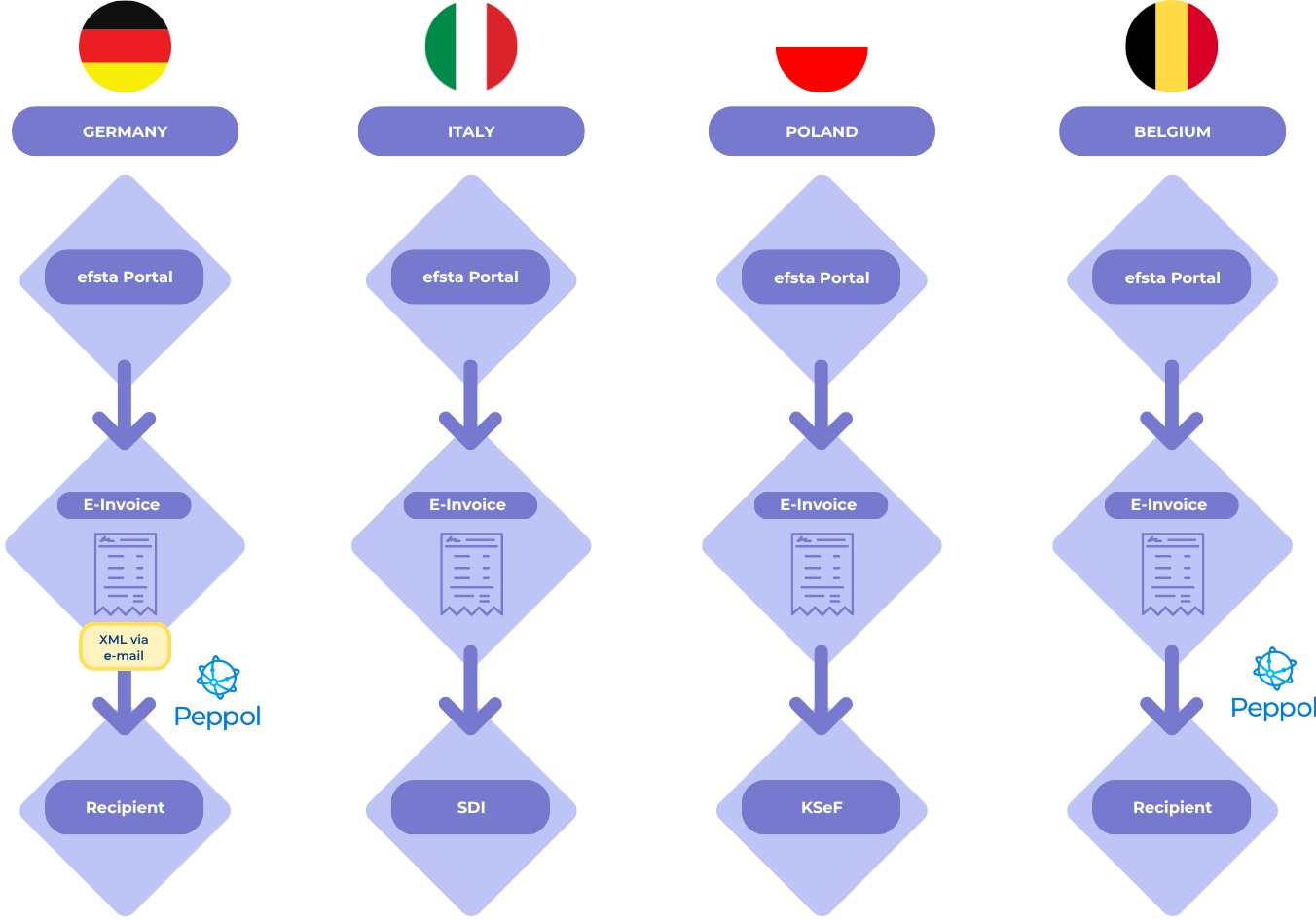
The diagram shows e-invoicing transition processes for Germany, Italy, Poland, and Belgium, including their respective e-invoicing portals, transmission methods, and recipient systems.

Belgium

As of January 1, 2026, electronic invoicing is mandatory for all B2B transactions. Implementation is based on the Peppol BIS 3.0 standard and enables structured, automated processing of e-invoices.

efsta is a certified Peppol Access Point Provider and is fully prepared to meet the requirements. Companies can connect their systems directly to the Peppol network, send e-invoices in compliance with regulations, and benefit from scalable, audit-proof operations.

More about Peppol in Belgium
Belgium Outline map with pin
Outline map of Germany with location marker in the colors of the German flag.

Germany

The use of e-invoices has been mandatory since January 1, 2025. Businesses must be able to receive and process e-invoices, while transitional provisions apply to the issuance of e-invoices until the end of 2027.

The standard format is XRechnung, which enables structured and automated processing. These requirements are increasingly affecting the B2B sector as well and are driving the standardization of digital invoicing processes.

Our solution for GermanyLearn more about the XRechnung software

Italy

Electronic invoicing has been mandatory in the B2B sector since 2019. Processing takes place via the SDI system (Sistema di Interscambio) and is based on structured data formats to ensure automated, compliant processing.

efsta supports integration with the SDI system and enables seamless connectivity with existing POS, ERP, and back-office systems.

Arrange an appointment now
Outline map of Italy with location marker in the colors of the Italian flag.
Outline map of Poland with location marker in the colors of the Polish flag.

Poland

As of February 1, 2026, electronic invoicing is mandatory in the B2B sector. Processing takes place via the government system KSeF (Krajowy System e-Faktur) and is based on a prescribed XML format.

Companies are required to ensure seamless integration with the KSeF API, validate invoice data, and convert it to the prescribed XML format. Additionally, the invoice status must be tracked in real time, and archiving must be ensured in accordance with Polish regulations.


Our solution for GermanyMore about KSeF in Poland

Technical Information in efstaDocs

Integrators and technical teams can find further details on the architecture, configuration, API integration, use cases, and country-specific information in efstaDocs. The documentation explains how the e-invoicing system is structured and how the integration can be implemented.
E-Invoicing Documentation

Individual advice from our experts

We are always available to answer your questions and find a suitable solution for your requirements.
Get in touch

FAQs - Frequently Asked Questions About E-Invoicing

What is an e-invoice?
What software is suitable for e-invoices?
Can you create e-invoices with efsta?
What formats are supported for e-invoices?
How are errors in e-invoices detected?
Can I track the status of e-invoices?

Pachergasse 17 / Top 11
4400 Steyr, Austria

Business hours:
‍Mo-Thu
: 8 am - 5 pm
Fri: 8 am - 12 noon

We are closed on Austrian public holidays.

© 2026 All rights reserved